What Are Greenfield and Brownfield Investments? How Do They Differ When Investing in a Manufacturing Facility?
B68e53c3 B0b0 404b 8ce9 F3aebece508e

When a company decides to expand its production base or invest in Thailand, one of the key questions it needs to consider is: “What type of development approach should be used for the new facility?”

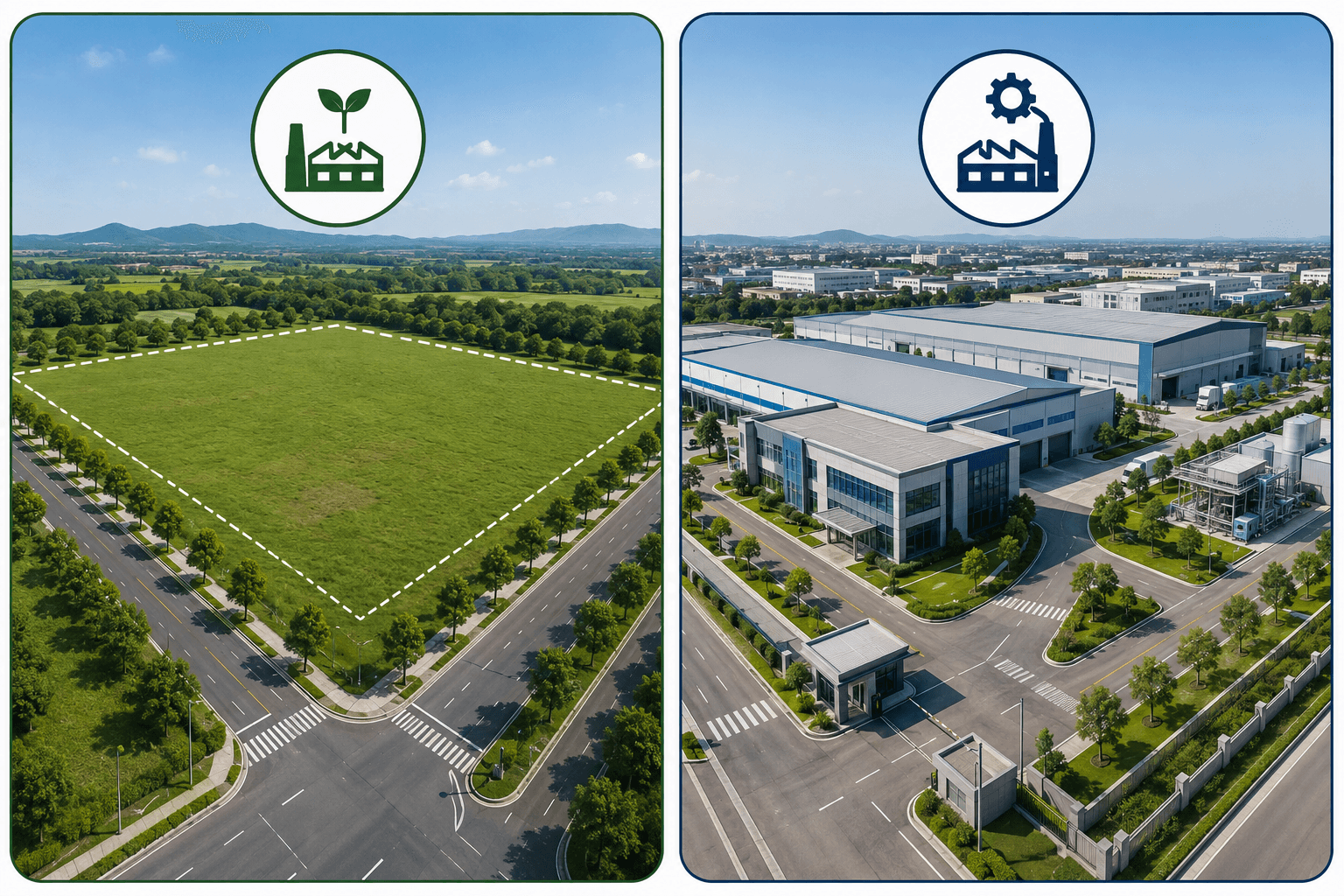
In general, investors may consider two approaches: Greenfield Investment and Brownfield Investment. These approaches differ in terms of site selection, project design, development timelines, investment costs, and flexibility in adapting facilities to specific manufacturing processes.

Understanding the differences between Greenfield and Brownfield Investment is therefore an important part of investment planning, as the approach selected can affect project costs, time to start operations, and the ability to expand the business in the future.

What Is Greenfield Investment?

Greenfield Investment refers to the development of a new project on land without existing factories or production facilities. This allows investors to plan and design the project from the outset according to their specific manufacturing processes and requirements.

For example, a foreign company seeking to establish a new manufacturing base in Thailand may purchase or lease industrial land and develop a new factory, buildings, production systems, and related utilities from the ground up.

Advantages of Greenfield Investment

  1. Factory Design Tailored to Specific Requirements
    Investors can plan the factory layout, machinery arrangement, production systems, and supporting areas to align with their manufacturing processes from the beginning.
  2. Greater Flexibility to Adopt New Technologies
    Without being constrained by existing structures, factory designs can incorporate Automation, Digital Systems, and new manufacturing processes from the outset.
  3. Greater Flexibility for Long-Term Planning
    Space can be allocated for future production expansion, additional buildings, or utility systems to accommodate future growth.

What Is Brownfield Investment?

Brownfield Investment refers to investing in an existing site, building, factory, or infrastructure and adapting or upgrading it to meet the requirements of a new business.

This approach may be suitable for companies seeking to begin operations more quickly or those that can effectively utilize existing structures without having to build everything from scratch.

Advantages of Brownfield Investment

  • Potentially shorter project development timelines
  • Ability to utilize existing buildings or infrastructure
  • Reduced need for certain construction work
  • Suitable for projects that can effectively adapt existing structures

However, Brownfield projects may face limitations arising from existing structures, such as building layouts, electrical systems, water systems, or available space for machinery installation. Therefore, Brownfield Investment does not necessarily mean lower costs than Greenfield Investment, as investors still need to assess the costs of renovations and system modifications required to meet their manufacturing needs.

Which Approach Should Investors Choose?

Investors Should Consider at Least Five Factors:

  1. Investment budget
  2. Desired timeline for starting production
  3. Manufacturing process requirements
  4. Infrastructure requirements
  5. Future production expansion plans

For projects that require a factory to be designed specifically around their manufacturing processes and long-term growth plans, Greenfield Investment may offer greater flexibility. Meanwhile, Brownfield Investment may be more suitable for projects that can effectively utilize existing structures.

For investors choosing to develop a new facility through a Greenfield approach, selecting an industrial site with established infrastructure and utility systems can be an important consideration during project planning.

304 Industrial Park offers industrial land in Prachinburi and Chachoengsao provinces, supported by infrastructure and utility systems, including electricity and industrial water. The industrial park has more than 3,200 rai of available land and 9 developed projects.

Therefore, for businesses considering a Greenfield Investment, selecting a site with infrastructure already in place can be an important factor to consider alongside project costs and operational plans.


304 Industrial Park

Creating a future-ready ecosystem for businesses, with green energy, complete facilities, and global connectivity.

Contact Us
Contact Bg